Introduction
Advanced Business Data Analysis is the foundation of modern enterprise intelligence. Organizations collect vast amounts of data daily. However, without a structured analytical framework, that data remains underutilized.
Advanced Business Data Analysis converts raw information into measurable business value. It aligns KPIs, forecasting models, and performance indicators into a unified strategic view. As a result, decision-makers operate with greater confidence and precision.
Moreover, companies that implement advanced analytics frameworks gain a sustainable competitive advantage. They predict trends instead of reacting to disruptions.
The Strategic Role of Advanced Business Data Analysis
Advanced Business Data Analysis reshapes how enterprises approach decision-making. Traditional reporting focuses on historical outcomes. Modern analytics focuses on predictive and prescriptive insights.
For example, financial analytics can forecast revenue trends before market shifts occur. As a result, organizations adjust investment strategies proactively. In addition, operational analytics identifies inefficiencies that impact productivity.
However, success depends on alignment between analytics systems and business objectives. Therefore, leadership involvement remains critical throughout implementation.
Enterprises that embed analytics into their core strategy experience faster execution and improved cross-functional collaboration.
Core Pillars of Advanced Business Data Analysis
A successful Advanced Business Data Analysis strategy relies on three essential pillars.
Data Governance and Quality Control
Reliable insights depend on accurate data. Therefore, enterprises must establish strict governance standards.
Data validation processes reduce errors and inconsistencies. As a result, analytical outputs remain trustworthy and actionable.
In addition, centralized data management ensures transparency across departments.
Predictive Intelligence and Automation
Predictive analytics identifies patterns within historical datasets. Automation enhances efficiency by reducing manual analysis.
For instance, machine learning algorithms forecast customer demand and operational risks. Moreover, automated alerts notify executives of performance deviations.
As a result, organizations respond faster to emerging challenges.
However, predictive systems require continuous monitoring to maintain accuracy.
Executive Reporting and Visualization
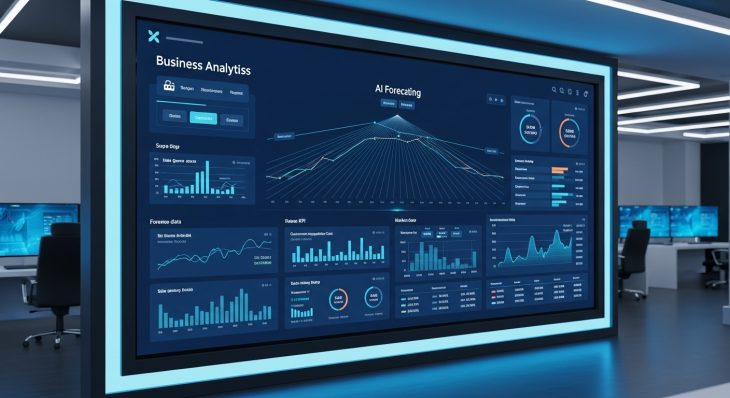
Advanced Business Data Analysis must translate complexity into clarity. Interactive dashboards simplify enterprise-wide insights.
They present KPIs, performance trends, and financial forecasts in real time. Therefore, executives gain immediate visibility into strategic priorities.
Moreover, visualization tools improve communication across departments. Clear data storytelling enhances decision alignment.
Business Impact and Competitive Advantage
Advanced Business Data Analysis drives measurable outcomes across every department.
First, it enhances financial forecasting accuracy. As a result, companies allocate resources more effectively.
Second, it strengthens risk management frameworks. Moreover, organizations simulate multiple strategic scenarios before implementation.
Third, it improves operational performance. For example, supply chain analytics reduces downtime and lowers costs.
In addition, marketing teams leverage behavioral analytics to increase campaign efficiency. Therefore, ROI improves significantly.
Organizations that fully integrate analytics into their operations consistently outperform competitors.
Implementation Challenges and Solutions
Despite its advantages, Advanced Business Data Analysis requires disciplined execution.
Data fragmentation often limits insight generation. Therefore, enterprises must unify their systems through scalable infrastructure.
In addition, skill shortages can slow progress. Many companies invest in training programs to strengthen internal capabilities.
Security remains a top priority. Sensitive enterprise data must be protected through encryption and access control policies.
Moreover, change management ensures long-term adoption. Employees must trust and understand analytical outputs to act confidently.
Conclusion
Advanced Business Data Analysis defines the future of enterprise strategy. It transforms disconnected datasets into actionable intelligence.
Moreover, it empowers leadership teams to anticipate risks and identify opportunities with precision. Organizations that prioritize Advanced Business Data Analysis achieve greater agility, resilience, and long-term growth. Therefore, enterprises must integrate analytics into their strategic foundation to remain competitive in a data-driven economy.