Introduction
Advanced Business Data Analysis is transforming how enterprises compete in modern markets. Organizations generate massive volumes of operational and financial data daily. However, without structured interpretation, that information cannot support strategic growth.
Advanced Business Data Analysis converts complex datasets into measurable insights. It connects performance metrics, predictive forecasting, and executive dashboards into a unified intelligence framework. As a result, leadership teams make faster and more confident decisions.
Moreover, companies that adopt advanced analytics gain stronger resilience. They anticipate disruption instead of reacting under pressure.
The Business Value of Advanced Business Data Analysis
Advanced Business Data Analysis provides clarity in uncertain environments. Traditional reporting explains historical performance. However, predictive analytics forecasts what is likely to happen next.
For example, revenue forecasting models identify potential slowdowns before they impact quarterly targets. As a result, executives adjust resource allocation proactively. In addition, operational analytics reveals inefficiencies that reduce profitability.
Moreover, advanced analytics enhances transparency across departments. Finance, operations, and marketing teams rely on shared data models. Therefore, decision-making becomes aligned and consistent.
When analytics integrates with strategy, performance improves across the organization.
Infrastructure Behind Advanced Business Data Analysis
A strong Advanced Business Data Analysis strategy requires a stable infrastructure.
Centralized Data Ecosystems
Fragmented systems limit insight generation. Therefore, enterprises implement centralized data warehouses or scalable cloud platforms.
This integration ensures consistent reporting and real-time visibility. As a result, executives access accurate insights without delay.
In addition, centralized systems improve data governance and reduce duplication errors.
AI-Driven Predictive Modeling
Predictive modeling identifies patterns in historical data. Artificial intelligence strengthens forecasting accuracy through adaptive learning.
For instance, AI algorithms analyze customer behavior trends and market demand fluctuations. Moreover, automated systems generate alerts for performance anomalies.
As a result, leadership teams shift from reactive management to proactive strategy.
However, continuous monitoring remains essential to maintain model reliability.
Executive Analytics Dashboards
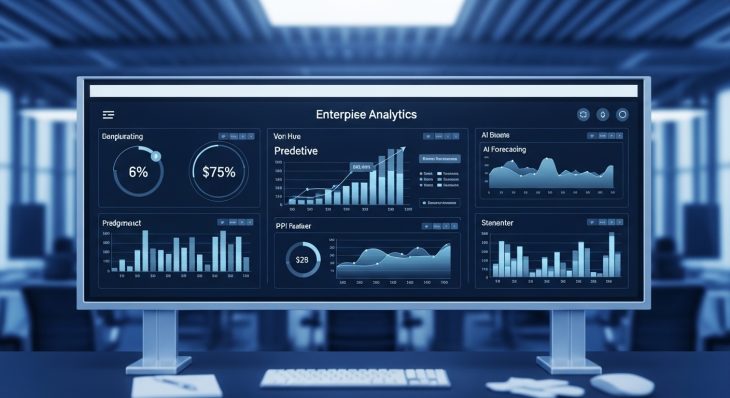
Advanced Business Data Analysis depends on clear visualization. Interactive dashboards transform raw numbers into strategic narratives.
They present KPIs, revenue projections, and operational indicators in real time. Therefore, executives respond quickly to emerging risks.
Moreover, well-designed dashboards improve communication between technical analysts and senior leadership.
Clarity in reporting leads to confident decision-making.
Competitive Advantages of Advanced Business Data Analysis
Advanced Business Data Analysis drives measurable growth.
First, it increases forecasting precision. As a result, enterprises allocate budgets and resources efficiently.
Second, it strengthens risk assessment frameworks. Moreover, companies simulate multiple scenarios before making investments.
Third, it enhances operational efficiency. For example, analytics optimizes supply chain processes and reduces cost overruns.
In addition, customer behavior insights improve marketing effectiveness. Therefore, organizations achieve higher ROI and improved retention rates.
Companies that fully integrate analytics outperform competitors in speed and agility.
Managing Implementation Challenges
Despite its benefits, Advanced Business Data Analysis requires strategic planning.
Data inconsistency can undermine accuracy. Therefore, governance policies must define validation standards.
In addition, skill gaps may slow progress. Enterprises often invest in analytics training programs to strengthen internal expertise.
Security also remains critical. Sensitive enterprise data must be protected through encryption and strict access controls.
Moreover, cultural adoption influences success. Employees must trust analytics outputs to act decisively.
When properly implemented, analytics becomes a long-term growth engine.
Conclusion
Advanced Business Data Analysis is a strategic driver of enterprise growth. It transforms fragmented datasets into predictive intelligence and actionable strategy.
Moreover, organizations that embed Advanced Business Data Analysis into their operations achieve greater resilience and sustained competitiveness. Therefore, enterprises must treat analytics as a core capability, not a supporting tool, in order to thrive in a data-driven economy.