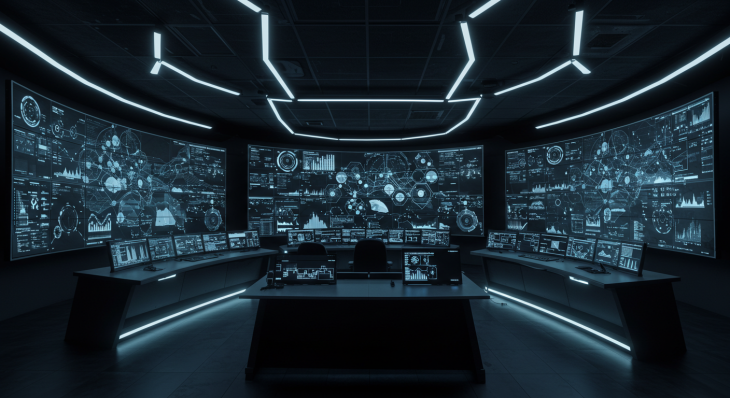
In modern urban operations, data is abundant — but meaning is rare. Thousands of sensors generate millions of data points every minute across Dubai’s infrastructure: temperature readings, vehicle counts, voltage levels, camera frames. Alone, these are just numbers. But in the right environment, they coalesce into understanding. Control rooms are where this transformation occurs — not through algorithms alone, but through the human capacity to synthesize, contextualize, and act. An operator doesn’t just see a spike in energy demand; they see a school turning on air conditioning, a metro station filling with commuters, a construction site powering heavy machinery — all at once. This layered perception is what turns raw input into actionable insight. The design of these spaces supports this cognitive work. Screens are arranged not for spectacle, but for logical flow. Colors are chosen for clarity, not aesthetics. Sound is calibrated to inform without overwhelming. Every element serves the operator’s ability to hold multiple realities in mind simultaneously. This is not passive monitoring. It is active cognition — a continuous process of pattern recognition, hypothesis testing, and mental modeling. The best control rooms feel less like technical hubs and more like observatories: places where the city’s hidden dynamics become visible. Operators develop an intuition for normalcy — the baseline hum of a functioning metropolis — so that deviations stand out like dissonant notes in a symphony. They don’t wait for alarms; they anticipate them. And when action is needed, it is precise, measured, and informed by a deep understanding of interconnected systems. In this space, data doesn’t shout. It whispers. And those who listen carefully can hear the future before it arrives.