Introduction
Advanced Business Data Analysis has become a strategic necessity for modern enterprises. Every organization generates continuous streams of operational, financial, and customer data. However, without structured analysis, this data remains an untapped asset.
Advanced Business Data Analysis converts complex datasets into strategic direction. It integrates forecasting models, performance indicators, and risk metrics into one intelligent framework. As a result, executives gain actionable insights rather than static reports.
Moreover, enterprises that prioritize analytics improve agility and long-term competitiveness. They respond to market shifts with clarity and confidence.
How Advanced Business Data Analysis Drives Smart Decisions
Advanced Business Data Analysis enables proactive leadership. Traditional business intelligence explains past performance. In contrast, advanced analytics predicts future outcomes.
For example, predictive revenue modeling highlights potential financial gaps before they occur. As a result, finance teams adjust allocations early. In addition, operational analytics detects inefficiencies that affect productivity.
However, successful adoption requires executive alignment. Strategy must define what data is analyzed and why. Therefore, organizations must connect analytics initiatives to measurable objectives.
When analytics supports strategic planning, decision cycles become shorter and more accurate.
Key Elements of Advanced Business Data Analysis
An effective Advanced Business Data Analysis strategy relies on three core elements.
Integrated Data Infrastructure
Data fragmentation limits visibility. Therefore, enterprises centralize systems through cloud platforms or enterprise data warehouses.
This integration ensures consistent reporting across departments. As a result, decision-makers access synchronized insights in real time.
Moreover, unified data environments reduce redundancy and operational errors.
Predictive Modeling and AI Insights
Predictive analytics identifies patterns within historical datasets. Artificial intelligence enhances this process through adaptive learning.
For instance, AI-driven systems forecast customer behavior, market demand, and risk exposure. In addition, automated alerts notify leadership about performance deviations.
As a result, executives move from reactive management to proactive strategy.
However, predictive systems must be continuously monitored and refined to maintain reliability.
Executive-Level Visualization
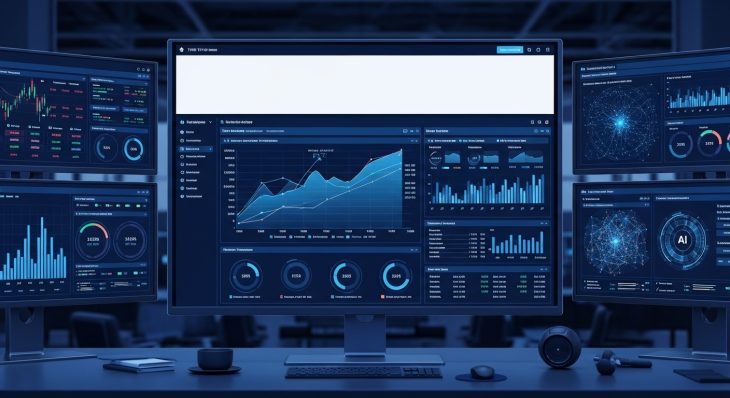
Data complexity must be simplified. Advanced Business Data Analysis uses interactive dashboards to deliver clarity.
These dashboards present KPIs, revenue projections, and performance benchmarks in structured formats. Therefore, leadership teams make faster, data-driven decisions.
Moreover, visual reporting enhances communication between technical and non-technical stakeholders.
Clear visualization turns analytics into strategic storytelling.
Enterprise Benefits and Long-Term Impact
Advanced Business Data Analysis provides measurable enterprise-wide advantages.
First, it increases forecasting accuracy. As a result, resource planning becomes more efficient.
Second, it strengthens risk mitigation strategies. Moreover, organizations evaluate multiple scenarios before strategic investments.
Third, it improves operational performance. For example, analytics reduces supply chain delays and improves inventory management.
In addition, marketing departments refine segmentation using behavioral data. Therefore, campaign ROI improves significantly.
Companies that embed analytics into daily operations achieve stronger resilience and sustained growth.
Overcoming Adoption Barriers
Despite its benefits, Advanced Business Data Analysis presents implementation challenges.
Data quality remains a major concern. Therefore, governance policies and validation standards are essential.
In addition, workforce skill gaps may slow progress. Many enterprises invest in analytics training to strengthen internal capabilities.
Security also plays a critical role. Sensitive enterprise data must be protected through encryption and strict access controls.
Moreover, organizational culture influences success. Employees must trust analytics systems to act confidently on insights.
When implementation is structured and strategic, analytics becomes a long-term competitive advantage.
Conclusion
Advanced Business Data Analysis is not a temporary trend. It is the foundation of intelligent enterprise management.
Moreover, it transforms fragmented information into predictive intelligence and strategic foresight. Organizations that adopt Advanced Business Data Analysis gain clarity, efficiency, and measurable growth. Therefore, enterprises must integrate analytics into their strategic core to remain competitive in a data-driven economy.