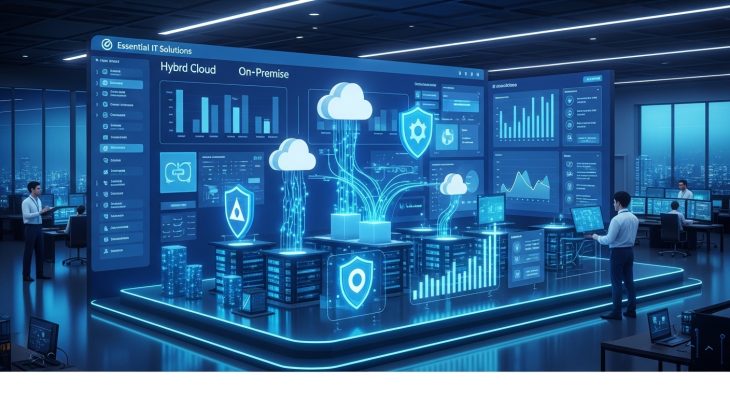
Digital transformation is accelerating across every industry. Therefore, organizations must invest in Essential IT Solutions that align technology with business objectives. Without a structured IT strategy, growth becomes fragmented and inefficient.
Modern enterprises depend on scalable systems, secure networks, and intelligent automation. However, technology alone is not enough. Essential IT Solutions combine infrastructure, cybersecurity, and operational efficiency into one cohesive ecosystem.
Why Essential IT Solutions Matter
Businesses today operate in hybrid and cloud-driven environments. Therefore, integrated IT architecture is critical for performance and resilience.
Essential IT Solutions streamline communication between systems. In addition, they reduce downtime and improve data visibility. For example, centralized IT frameworks allow real-time monitoring across departments.
According to Gartner, organizations that modernize IT infrastructure increase operational efficiency and reduce risk exposure. As a result, IT becomes a growth enabler rather than a support function.
Moreover, structured IT planning strengthens cybersecurity posture. This ensures business continuity even under high operational pressure.
For deeper insights into infrastructure optimization, explore our internal guide on enterprise technology strategy:
👉 https://sagecontrolroom.com/technology
Core Components of Essential IT Solutions
An effective IT ecosystem is built on multiple integrated layers. Each layer supports performance, security, and scalability.
1️⃣ Infrastructure Optimization
Modern infrastructure includes cloud platforms, data centers, and edge computing. Therefore, system architecture must be scalable and flexible.
Virtualization and load balancing improve performance stability. In addition, proactive monitoring reduces unexpected downtime.
Moreover, redundancy planning ensures uninterrupted operations. This is especially critical in high-availability environments such as mission-critical o
2️⃣ Cybersecurity & Network Protection
Security is a foundational part of Essential IT Solutions. However, it must be proactive, not reactive.
Advanced firewalls, endpoint protection, and intrusion prevention systems work together to block threats. In addition, centralized dashboards provide unified visibility.
For example, organizations implementing layered security models reduce breach probability significantly. As a result, customer trust and compliance readiness improve.
Learn more about integrated cybersecurity strategies in our operations-focused framework:
👉 https://sagecontrolroom.com/operations
3️⃣ Automation & System Integration
Automation reduces manual tasks and improves workflow efficiency. Therefore, IT teams focus on strategic innovation instead of repetitive maintenance.
System integration connects CRM, ERP, analytics, and communication platforms. In addition, API-driven architecture improves flexibility.
Moreover, intelligent dashboards provide actionable insights. For example, performance metrics can trigger automated alerts before issues escalate.
Essential IT Solutions in Hybrid & Cloud Environments
Hybrid environments combine on-premise and cloud services. However, without centralized management, complexity increases rapidly.
Essential IT Solutions provide unified control panels for multi-cloud deployments. In addition, micro-segmentation enhances network security.
Moreover, disaster recovery strategies ensure business continuity. As a result, enterprises remain operational even during unexpected disruptions.
Scalable cloud architecture also supports future growth. Therefore, companies can expand operations without redesigning their entire IT ecosystem.
Best Practices for Implementing Essential IT Solutions
First, conduct a comprehensive IT audit. Identify system gaps and inefficiencies. Therefore, your strategy becomes data-driven.
Second, align IT investments with long-term business goals. However, avoid overcomplicating infrastructure unnecessarily.
Third, prioritize cybersecurity integration from the start. In addition, establish clear governance policies.
Moreover, monitor performance continuously. Regular assessments ensure your Essential IT Solutions evolve alongside your organization.
Business Impact of Essential IT Solutions
Strategic IT implementation directly affects profitability and productivity. Therefore, downtime costs decrease and operational agility increases.
In addition, automated systems reduce human error. For example, predictive analytics can prevent hardware failures before they occur.
Moreover, streamlined communication across departments improves decision-making speed. As a result, enterprises gain competitive advantage.
Ultimately, Essential IT Solutions transform technology into a strategic asset rather than a maintenance expense.
Conclusion
Technology will continue evolving. However, businesses that implement Essential IT Solutions build resilient, scalable, and secure infrastructures.
By combining optimized infrastructure, proactive cybersecurity, and intelligent automation, organizations ensure sustainable growth. Therefore, investing in Essential IT Solutions is a strategic move toward long-term operational excellence.0