In today’s competitive economy, Strategic Business Analysis is no longer optional. It is the foundation of intelligent decision-making and sustainable growth.
Organizations that invest in Strategic Business Analysis gain clarity across operations, finance, and market positioning. As a result, leaders move from reactive decisions to proactive strategy.
However, analysis must be structured. Without the right framework, data becomes noise instead of insight.
Why Strategic Business Analysis Matters
Strategic Business Analysis connects performance metrics with long-term business objectives. It transforms raw information into measurable action.
Moreover, it aligns leadership teams around shared data insights. Therefore, departments stop operating in silos.
When executives rely on structured analysis, they reduce uncertainty. In addition, they improve capital allocation and operational efficiency.
Companies that follow methodologies recommended by trusted research firms like Gartner often achieve measurable ROI and stronger market positioning.
Core Components of Strategic Business Analysis
Data Intelligence and Forecasting
Data is the backbone of Strategic Business Analysis. However, collecting data is not enough.
Advanced analytics platforms convert complex datasets into dashboards and predictive models. As a result, leaders anticipate trends before competitors.
Machine learning improves forecasting accuracy over time. For example, demand predictions become more precise with every data cycle.
You can explore how analytics integrates with technology infrastructure in our guide to
👉 Advanced IT Solutions for Enterprise Growth (Internal Link)
Risk Assessment and Scenario Planning
Risk modeling is essential in volatile markets. Strategic Business Analysis identifies operational and financial vulnerabilities early.
Moreover, scenario planning prepares companies for economic shifts. Therefore, crisis management becomes structured rather than chaotic.
Businesses that simulate multiple outcomes respond faster during disruptions.
For deeper protection strategies, see
👉 Enterprise Security Strategy for a Connected World (Internal Link)
Performance Benchmarking
Benchmarking compares internal KPIs against industry standards.
As a result, organizations identify inefficiencies before they escalate. In addition, benchmarking improves accountability across departments.
Clear metrics create measurable improvement cycles.
Image (Inside Article)
Image Placement: After this section
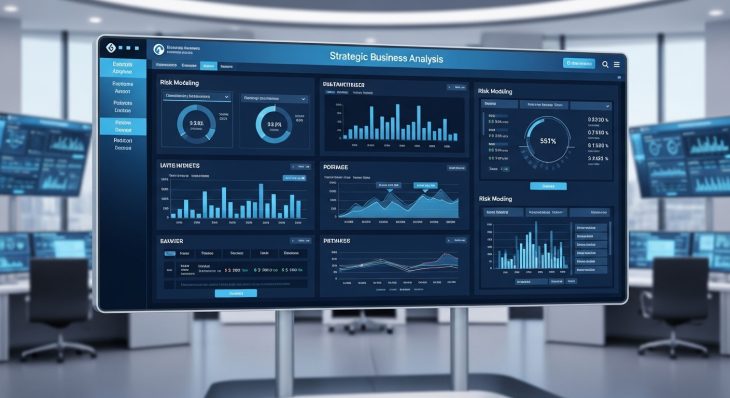
Alt Text: Strategic Business Analysis dashboard with predictive analytics
Business Benefits of Strategic Business Analysis
Strategic Business Analysis improves operational visibility.
Moreover, it strengthens financial discipline. Leaders allocate budgets with greater confidence.
In addition, it enhances competitive positioning. Companies that monitor trends continuously outperform slower rivals.
As a result, decision-making becomes faster and more accurate.
Implementation Strategy for Strategic Business Analysis
First, assess your current data maturity.
Then, identify gaps in analytics, reporting, and KPI alignment.
Moreover, integrate analytics platforms across departments. Fragmented systems reduce accuracy.
Finally, measure success using performance indicators tied directly to strategic objectives.
Strategic Business Analysis must evolve continuously. Therefore, optimization never stops.
Conclusion
Strategic Business Analysis is the engine behind sustainable enterprise growth.
Organizations that embed Strategic Business Analysis into leadership culture reduce risk, improve efficiency, and increase profitability.
If you aim for long-term competitive advantage, Strategic Business Analysis must be central to your strategy.