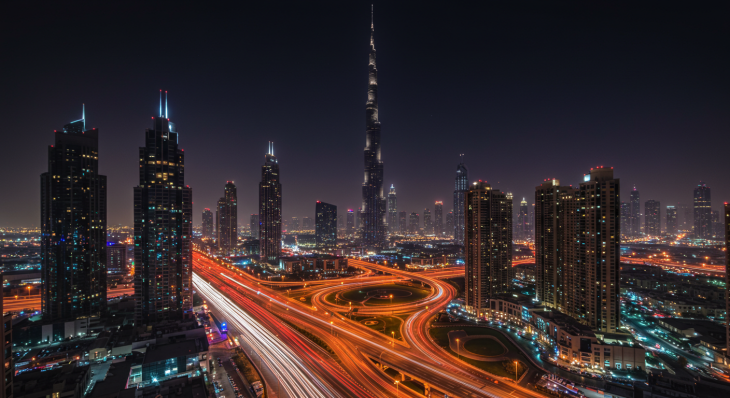
In the stillness before dawn, when the desert air cools and the city’s lights soften, Dubai does not sleep. Beneath its glittering towers and silent highways, a different kind of life stirs — not of people, but of systems. Data flows through fiber-optic veins. Sensors hum in tunnels. Cameras blink like watchful stars. This is the city’s quiet pulse, monitored not by chance, but by design. In rooms shielded from public view, operators sit before walls of light, tracking the rhythm of a metropolis that never truly rests. They do not command traffic or dispatch emergency crews in the dramatic sense. Instead, they observe. They notice the subtle shift in a power grid’s frequency, the unusual stillness of a normally busy intersection, the faint anomaly in a water pressure reading. Their work is not about intervention, but awareness — a continuous, silent dialogue between human and machine. Dubai’s efficiency is often praised as a marvel of engineering, but it is equally a triumph of sustained attention. Every train that arrives on time, every streetlight that glows without fail, every drop of water that reaches a tap — all are outcomes of this unseen vigilance. The control room is not a cockpit of control, but a sanctuary of perception, where the city reveals itself in streams of numbers, colors, and motion. Here, time is not measured in hours, but in response latencies and system uptimes. The operators speak little. Their language is one of glances, nods, and keystrokes. They understand that in a city built on precision, the smallest deviation can ripple outward. So they watch. They listen. They remember. And in doing so, they allow millions to move through their days with the quiet confidence that everything is, and will remain, in place.